
Search Adams County Released Inmates
Adams County Released Inmates records are easiest to start with at the jail roster and the sheriff's office. If you want to confirm a recent booking, check whether a person is still in custody, or follow a case after release, the county tools give you a clean path. The Adams County Jail roster shows current inmates only, while the sheriff's office and Wisconsin court records help you move from a name to the right file. When the county record runs out, state tools can fill the gap.
Where to Find Adams County Released Inmates
The Adams County Jail Division page is the first local stop for release tracking. It lists the jail at 401 Adams Street, Suite 1, Friendship, and it gives the contact path you need if you want to ask about an inmate, a visit, or a record. The jail administrator, Melissa Simcakowski, is listed with a direct phone number and email, which makes it easier to reach the right office when a record does not show enough detail online.
The jail page also matters because it ties the custody record to daily jail work. Video visitation and messaging are available. In-person visits must be scheduled. Property rules, commissary details, and mail directions are also posted there, so the page is useful even when you only need to verify that a person was held there at all. For a county with a modest jail operation, that single page carries a lot of weight. VINE alerts can add a status layer when a release or transfer matters.
The official Adams County Sheriff's Office Jail Division page at Adams County Sheriff's Office Jail Division is the best local source for those day-to-day details. It is also the page that connects the public to the jail phone, the jail administrator, and the rules that shape how released inmates are tracked in the county.
To keep the search grounded, use the county page before you guess. Small details matter. A person may be listed in custody one day and gone the next. That is why the county page is useful for quick checks, and why the court record becomes the next step when you need a fuller trail.
Note: The Adams County roster shows current inmates only, so older release details often require sheriff records or court case lookup.
The roster itself is separate from the jail division page, but the two work together. One tells you what the jail handles. The other tells you who is listed now. That split helps you avoid chasing a stale record when the person you are checking has already moved on.
For released inmates, that distinction is important. County custody can end fast. Court records can still show the case, while the jail roster may no longer show the person at all. When those two sources disagree, the time stamp usually explains why.
The result is a simple local workflow. Start with the county jail page, then use the roster, and then move to the court record if you need to see how the case ended or whether the person still has a supervision link in another system.
If you are building a paper trail, save the jail page, the roster result, and the court case number together. That small habit makes it easier to compare the county record with the broader Wisconsin court record.
That approach also keeps the search honest. Adams County does not need a big system to be useful. It just needs the right page and a clear name.
When you know the right office, the rest goes faster. When you do not, the public page can still point you in the right direction.
That is often enough for the first pass.
The next step is the roster.
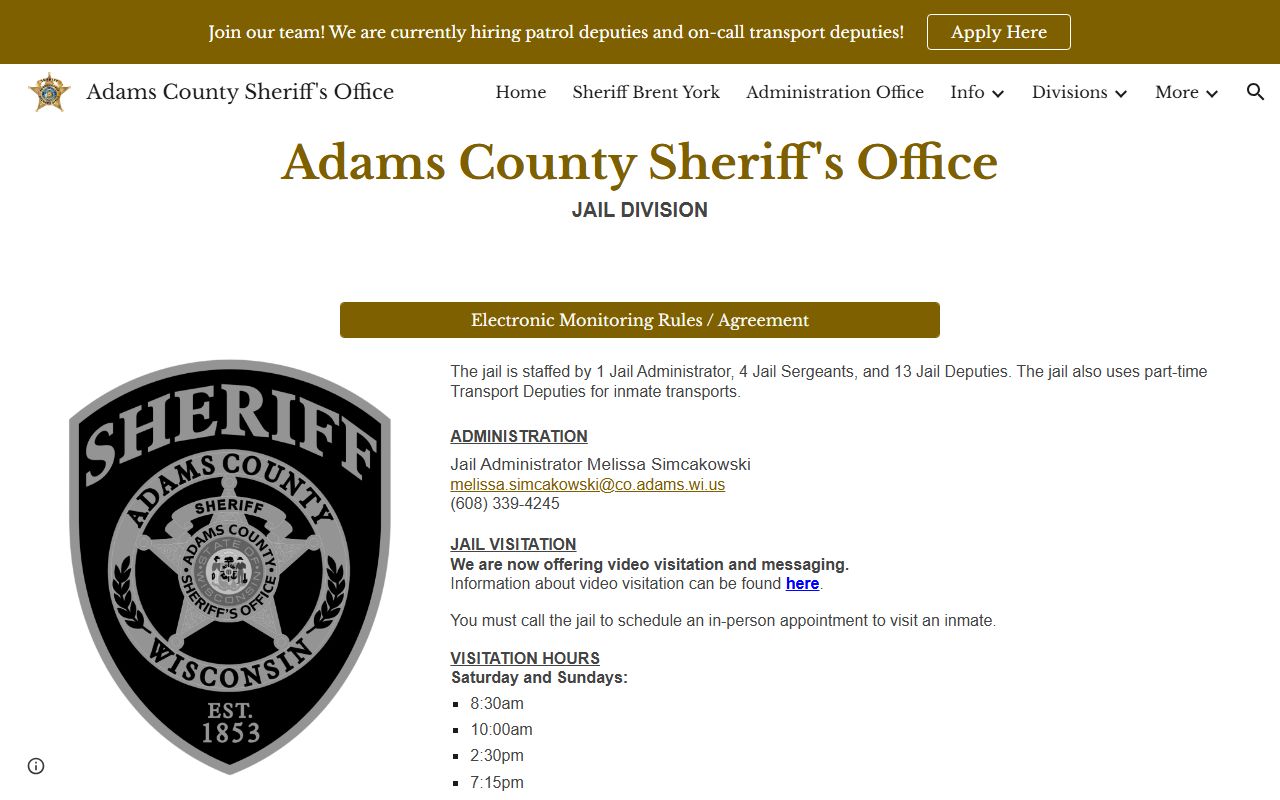
The Adams County Jail Division image above matches the official jail page and helps anchor your search to the correct county office.
Because the jail page includes visitation, messaging, and property guidance, it can also tell you whether the contact you need is about records or about jail operations. That saves time when you are trying to sort out a recent release.
If you need the roster rather than the policy page, the county provides that too. The roster is not the same thing as a full file, but it is the fastest way to check a name before you move to the courthouse.
Adams County Jail and Roster
The Adams County Jail at 401 Adams Street, Suite 1, Friendship, is small enough that the basics matter. The jail administrator and staff handle daily custody, visit scheduling, mail, inmate property, and commissary questions. Families can also use video visitation and messaging, which gives them a more direct way to stay in touch when a person is in custody.
The inmate roster at Adams County Jail Inmate Roster is the county's current custody tool. It shows current inmates only, and the site says the information and photos may contain errors. The county also puts a disclaimer on the page, so the record should be treated as a live reference, not a final legal finding.
The roster helps when you only have a name or a rough date. It is useful for quick checks after an arrest, after a transfer, or after a release. It can keep you from assuming that someone is still in the jail when they are not. That makes it a practical page for the first search and a poor fit for the last word.
Adams County also lists JailATM for money deposits and describes the commissary schedule. That is a small detail, but it matters to people who are still tied to the jail and trying to keep the line of contact open. The same jail page also explains how property is accepted and where it should be mailed.
The Adams County roster image above points back to the official inmate list, which is the right place to verify a current custody entry before you move to court records.
Because the roster is current only, it works best when used with the sheriff's office contact page. If a name is missing, the person may be out, booked elsewhere, or simply no longer on the live list. That is normal for a county roster and one reason the court record matters so much.
The sheriff's office at 301 Adams Street in Friendship handles the broader records side. The office phone, jail phone, and public records process give you a way to ask for older booking information or related arrest records when the live roster is not enough.
When a county page gives you custody and policy, it is doing its job. Adams County does that well. The job of the searcher is to know when to stop at the roster and when to ask for a file.
That line is clearer here than in many places.
The roster is a snapshot. The jail page is the frame.
Together, they show the county side of a released inmate search.
How to Search Adams County Released Inmates
Once you have the county name and a full or partial name, the Wisconsin Circuit Court Access system gives you the next layer. It is free, statewide, and built for case summaries across all 72 counties. Search by party name or case number, then use the docket to see whether the person had a criminal case, a traffic matter, or another file tied to the arrest.
For Adams County Released Inmates searches, WCCA helps when the jail roster no longer shows the person. The court record can still show the case number, hearing dates, charges, and the rough shape of the case. It does not give you the document images, but it tells you where the paper file lives. That is often enough to move to the right office with confidence.
Use Wisconsin Circuit Court Access when you want court history, and use the county roster when you want custody status. The two records are related, but they are not the same. That difference matters when you are checking a release.
If you are looking for a released person who moved from county custody into state supervision, the Wisconsin DOC Offender Locator can help. It searches state corrections records by name, birth year, race, gender, county, and DOC number. It can also show discharge dates and supervision status for people processed through the state system.
The state locator at Wisconsin DOC Offender Locator is not a county jail database, so it does not replace the Adams roster. It does, however, give you a useful follow-up when the county record ends and the state record begins. That is exactly the kind of handoff that comes up in a released inmates search.
When a record is not easy to find, move one step at a time. Use the county roster first, then use WCCA, and then check the DOC locator if the person may have entered state supervision. That order cuts down on false leads and keeps the search focused.
The system also keeps you from mixing up similar names. A case number, birth year, or court date can separate one record from another fast. That is especially useful in a county where the roster only gives you the live picture and not the full story.
WCCA updates often enough to help with recent filings, but county case conversion times vary. Some older files are well indexed. Others are not. If the entry looks thin, that may be a system limit, not a missing case.
That is why the county office remains important. The search may start online, but the record often ends at the courthouse.
Adams County Records Requests
If you need booking records, arrest records, or related jail files, the Adams County Sheriff's Office is the office to contact. The office follows Wisconsin Public Records Law, and the county contact information in the research gives you a direct path to the sheriff and jail. That is useful when a roster entry is not enough on its own.
Wisconsin's public records rules are set out in Wis. Stat. § 19.35. The law gives the public a right to inspect and copy records, subject to the usual exceptions. The Wisconsin Department of Justice also provides open government guidance through the Office of Open Government, which can help when a request needs to be framed more clearly.
That matters in Adams County because jail records are not all the same. Some people want a booking sheet. Others want visitation logs, property notes, or a copy of a record tied to a case. A clear request saves time for both sides and makes it more likely that the office can find the right file on the first pass.
The county sheriff's contact page can also help when you need to ask about a person who has already been released. A live roster will not always show an old release date. A records request can bridge that gap if the office still has the booking material in its system.
The Wisconsin State Law Library keeps a county topic page for inmates and related records at Wisconsin State Law Library county resources. That directory is handy when you want to compare Adams County with other counties or confirm which tools are official and current.
For many searches, the answer is simple. The roster tells you who is there now. The sheriff's office tells you how to ask for more. The court record tells you where the case went. That chain is enough to turn a name into a file.
Public records requests work best when they are narrow. Give the name, date range, and the type of record you want. The county can then decide whether the file is ready, partial, or limited by law.
That keeps the search clean and fast.
It also keeps the county response useful.
Released Inmates and Court Follow-Up
When someone is no longer in Adams County custody, the next step is often to check whether the case moved to another system. The federal inmate locator at Federal Bureau of Prisons Inmate Locator can help if the person was sentenced in federal court. The Wisconsin DOC Offender Locator can help if the person entered state supervision instead.
That follow-up is part of a good released inmates search. County records can end fast. Court records can stay useful for years. A release from Adams County does not erase the case, and it does not stop the public record trail from continuing in Wisconsin court systems or state corrections records.
If you need the complete court file rather than the live custody entry, the clerk of circuit court is the place to ask. WCCA will point you to the case, but the clerk is where the paper file lives. That office can tell you whether the document is public, whether it is sealed, and how to get a copy.
In practice, that means the county record is only the start. The released inmate record, the docket, and the sheriff's file each tell a different part of the story. Put together, they show where the person was held, when the record changed, and what office still has the paper trail.
The most useful searches stay local first. Adams County gives you that local start. State tools then fill in the rest.
When you need to compare a release against a court entry, keep the case number and the roster date side by side. That makes later review much easier and helps avoid mixing one person with another.
It also makes the county file easier to ask for. The office can work from a clear target instead of a broad guess.